
Criminal Court Cases in Lawrence County
Lawrence County divides criminal work by court level. General Sessions Judge Patricia McGuire hears misdemeanors punishable by no more than one year, reviews bonds, and conducts preliminary hearings in felony matters. A preliminary hearing tests whether enough evidence exists to move a felony forward. It is not the felony trial. Circuit Court is the felony trial court, and four judges of the 22nd Judicial District rotate assignments among Lawrence, Wayne, Giles, and Maury Counties. The same assigned judge may return for a later probation or parole violation.
The official Lawrence County court guide places General Sessions, Circuit, Juvenile, and Chancery functions at the courthouse. Juvenile files do not belong in an ordinary adult criminal search. Lawrenceburg Municipal Court, located with the city police department, handles city tickets and municipal violations. It does not replace the county docket for state misdemeanors or felonies.
The Lawrence County court guide also shows why a searcher must choose the right court before judging a result.
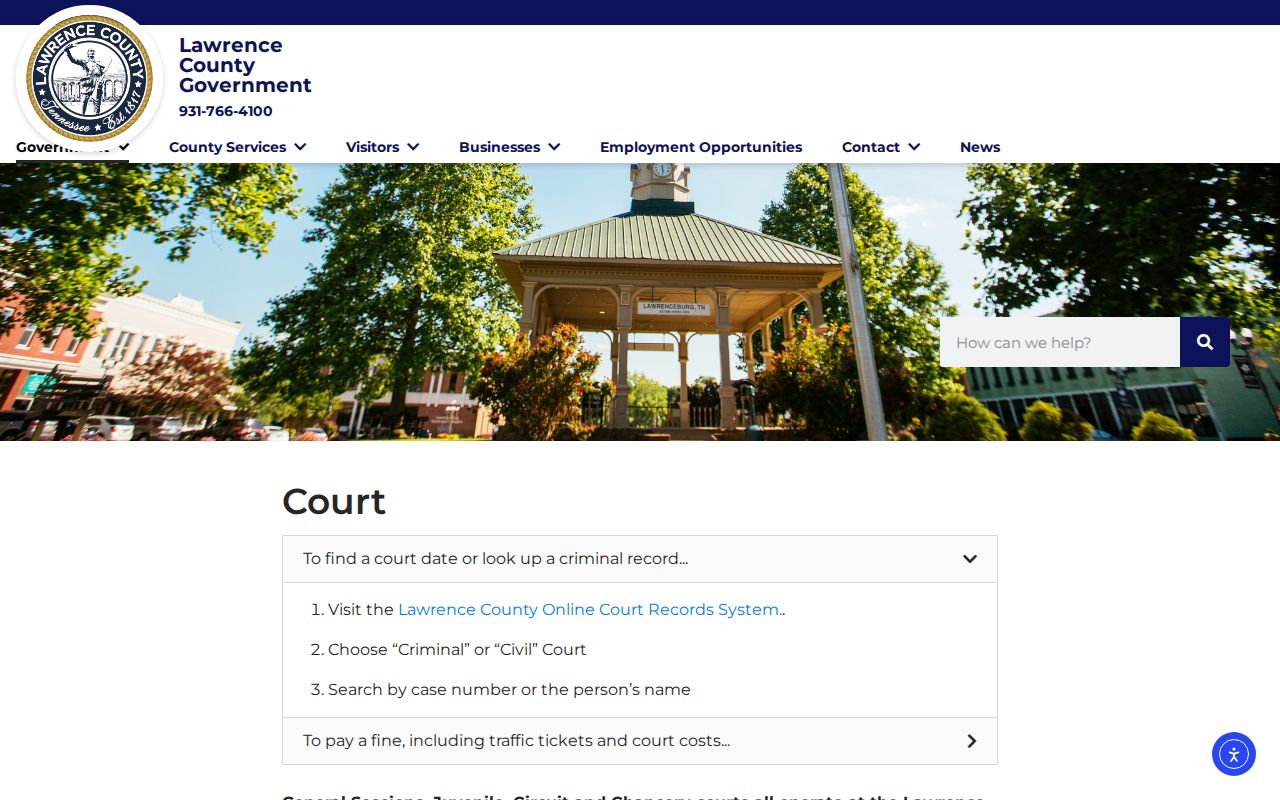
That court split determines which clerk can confirm the case and provide its public documents.
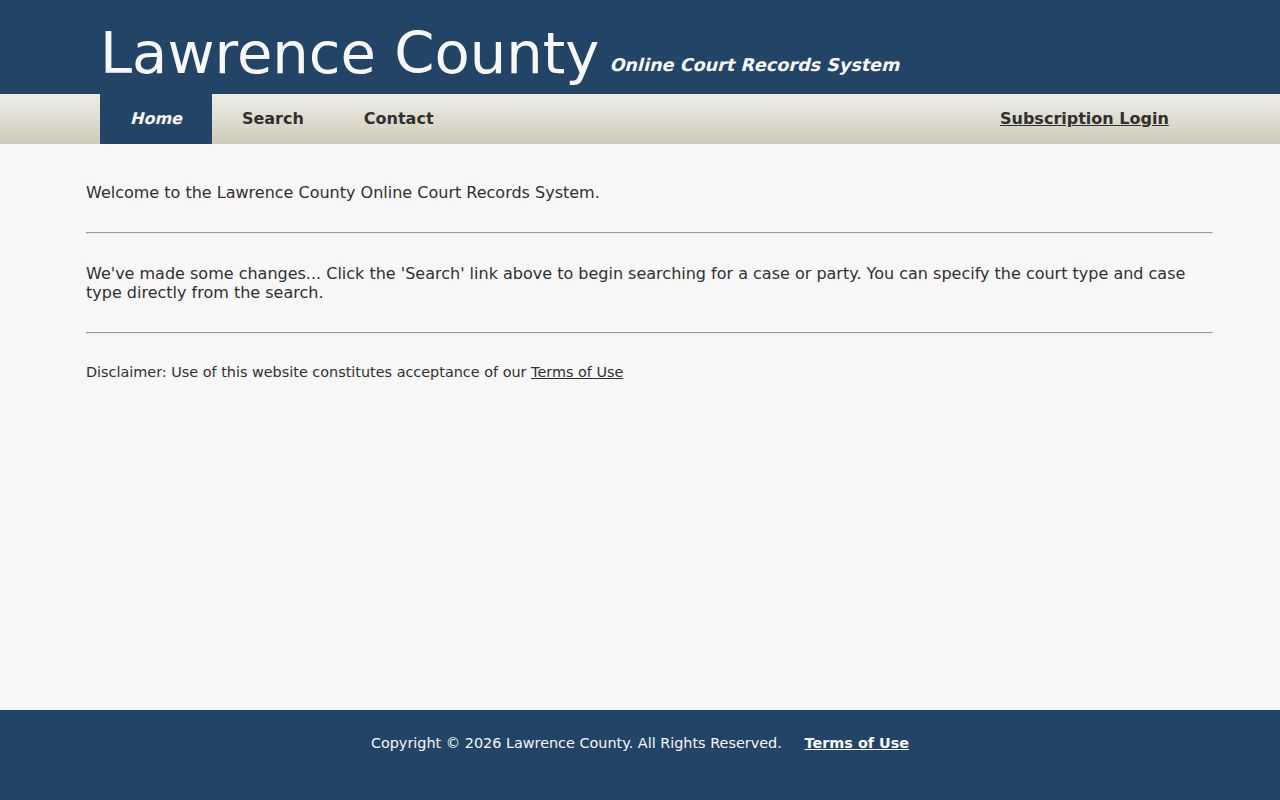
Lawrence County Case Record Searches
The Lawrence County portal is the main remote channel. A known case number is the strongest key. A full first and last name works when the number is unavailable. Search criteria compound, so adding a wrong year or court type can hide a valid match. The system caps results and offers a real-time filter for visible columns. The filter does not use the portal's phrase matching or typo tolerance.
- Open the local court search and choose Criminal rather than Civil.
- Enter the numeric part of a case number, or use the full party name.
- Select Circuit Court or General Sessions and add a case year only when it is reliable.
- Complete the verification, run “Find Now,” and open the matching row.
- Ask the Circuit Court Clerk for missing pleadings, certified copies, or confirmation of the final disposition.
The direct Lawrence County case search exposes more controls than the short county instructions describe.
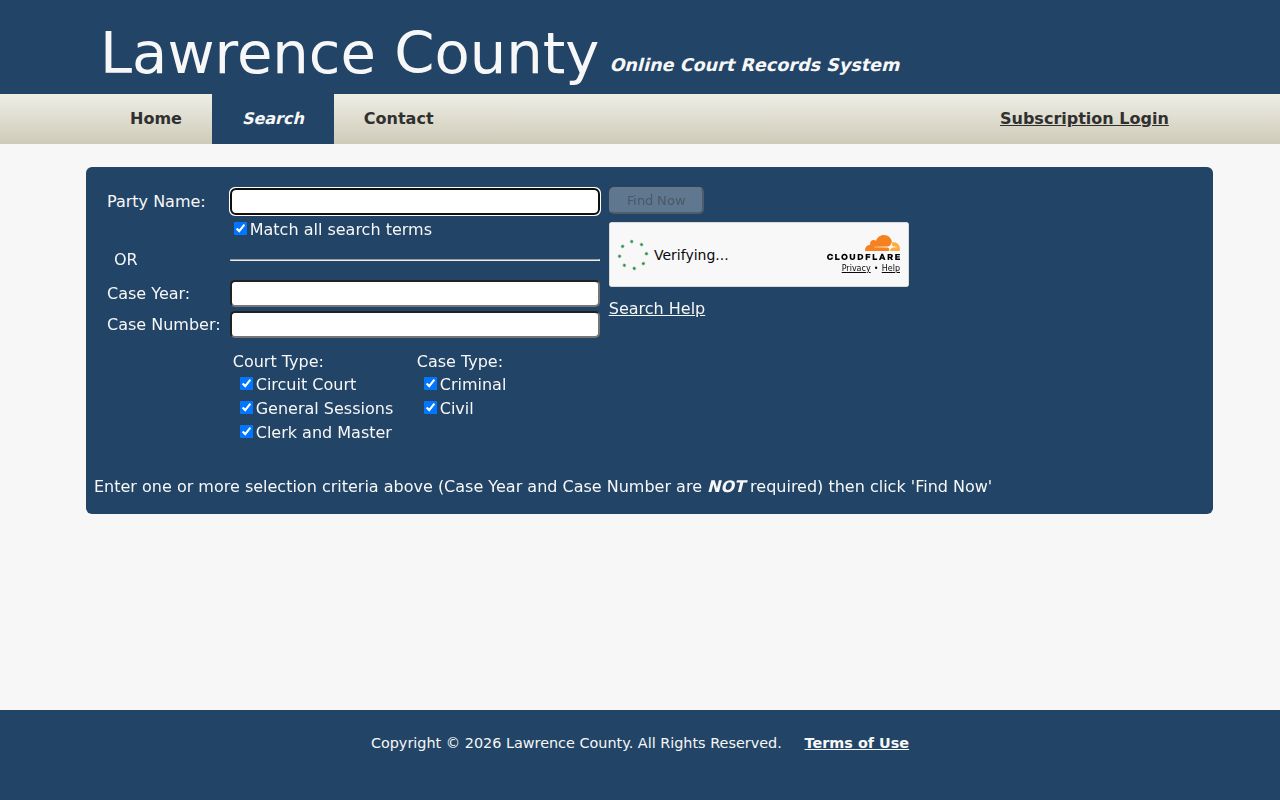
Those fields let a reader narrow a common name without assuming that an empty first try means no case exists.
| Field | Type | Requirement | Lawrence County Use |
|---|---|---|---|
| Party Name | Text, 100 characters | One criterion | Use full first and last name; an old reference number also works. |
| Case Year | Four-digit text | Optional | Usually the filing year. |
| Case Number | Text | Optional | Enter the numeric part after the final hyphen. |
| Court Type | Checkboxes | One combination | Circuit, General Sessions, or Clerk and Master. |
| Case Type | Checkboxes | One combination | Select Criminal for a prosecution. |
| Verification | Challenge | Required | Enables the “Find Now” button. |
Note: The portal warns that its display may be incomplete or non-current, so confirm any material result with the clerk.
Lawrence County Clerk Case Files
The Lawrence County Circuit Court Clerk is the operational custodian for Circuit, General Sessions, and Juvenile divisions. The office maintains dockets, minutes, revenue records, and official communications. Call or visit when the portal lacks a document, when a result is too new to trust, or when a certified disposition is needed. Describe the court, case number, party name, and document sought. Ask for a search or copy quote because no local criminal-copy fee schedule was established in the research.
The official Circuit Court Clerk page confirms the counter details and links back to the county search.
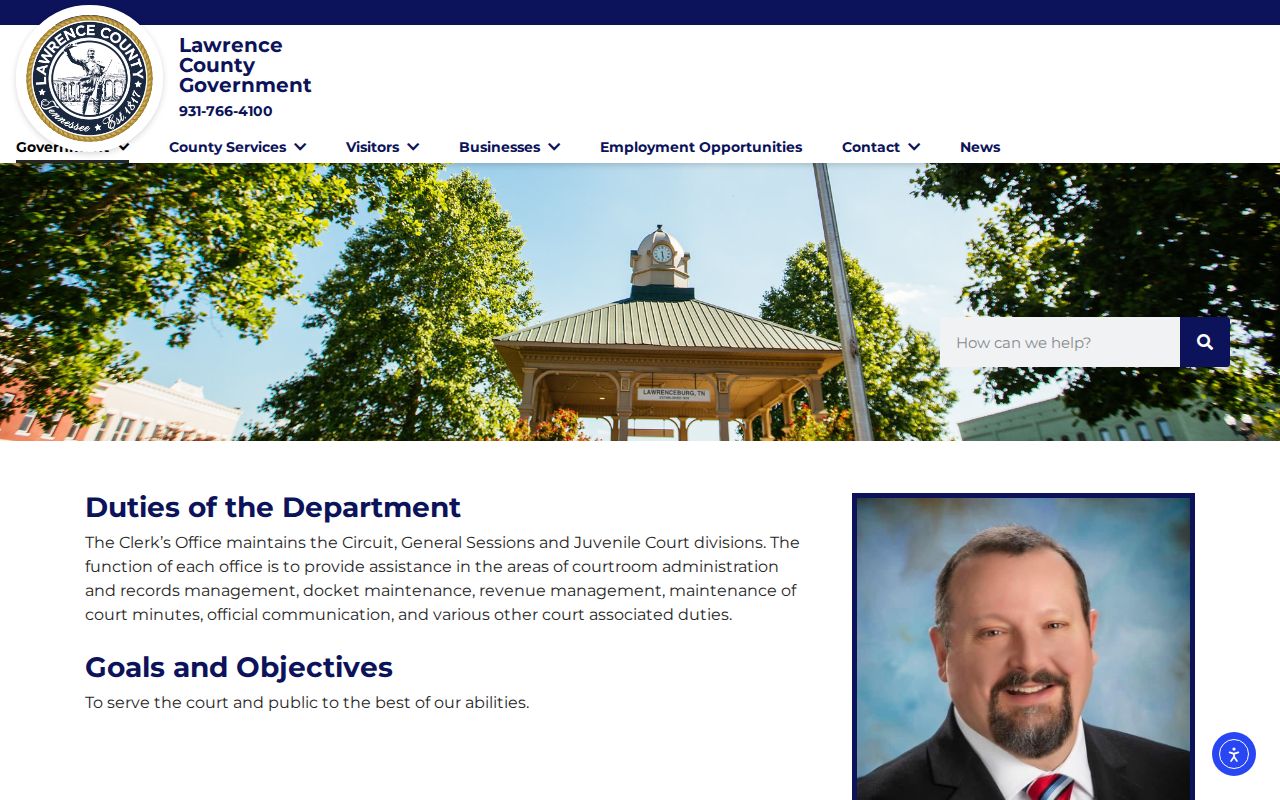
The Lawrence County clerk's office is the right place to reconcile the public index with the signed order in the actual file.
Circuit Court Clerk
240 W. Gaines St., NBU #12
Lawrenceburg, TN 38464
931-762-4398
Monday-Friday, 8:00 a.m.-4:30 p.m.
Lawrence County Courthouse
200 West Gaines Street
Lawrenceburg, TN 38464
931-766-4100
Call for general court information.
What a Criminal Case File Contains
A Lawrence County court file records the prosecution, not just the arrest. It can show what charge was filed after prosecutor review, when the defendant appeared, how the parties responded, and what the judge ordered. The online result may give only a subset. When counsel, bond detail, motions, or sentencing terms do not appear, request the public document from the clerk rather than filling the gap with an arrest report.
| Case Number and Court | Identifies the case, division, and correct record custodian. |
|---|---|
| Charging Document | States the offense the prosecutor filed, which may differ from the arrest charge. |
| Docket Entries | Chronological notices of filings, hearings, motions, and orders. |
| Hearing Dates | Shows scheduled settings and may reflect continuances or later changes. |
| Disposition and Judgment | Records dismissal, acquittal, plea, conviction, or other final action. |
| Sentence and Conditions | May state confinement, probation, fines, costs, and court-ordered terms. |
A case balance is one field within this larger file. It cannot, by itself, establish guilt or reveal how each charge ended.
Lawrence County Charges After Arrest
An officer records alleged offenses at arrest. The prosecutor later decides whether to file those charges, change them, add another count, or decline the case. That is why the jail label and court caption may not match. For a reader tracing one event, the Lawrence County arrest record explains the asserted grounds for custody, while the clerk's charging document and judgment show what entered the court system and how it ended.
Tennessee felony classes A through E belong in Circuit Court after the lower-court path. General Sessions hears misdemeanors and conducts felony preliminary proceedings. Classification can change through charging or a plea, so the judgment is more reliable than an early booking label. A class also does not decide whether a record qualifies for expungement.
Criminal Case Stages in Lawrence County
A Lawrence County misdemeanor may remain in General Sessions. A felony begins there for bond review and a preliminary hearing, then proceeds to Circuit Court for trial-level action. The online docket may show settings as the case advances, but a setting is not an outcome. Continuances and amended charges can change the path, and sealed material may never appear in the public display.
Case flow: Charges Filed › Arraignment › Pretrial › Plea or Trial › Disposition › Sentencing
Arraignment is the hearing where the charge is formally addressed and a plea may be entered. Pretrial entries can include motions and scheduling orders. A disposition states how a charge ended. Sentencing follows a conviction or plea when it is not imposed at the same event. The Lawrence County court case lookup should be checked again after a recent hearing, then verified through the clerk.
Note: A preliminary hearing is not a felony trial; it decides whether the case should proceed beyond General Sessions.
Lawrence County Municipal Case Limits
Lawrenceburg City Court handles municipal violations and city tickets at the Police Department. Those matters can remain outside the Lawrence County criminal search. A city citation should therefore be checked with the issuing municipal clerk. A state misdemeanor or felony follows the General Sessions and Circuit Court route instead. The physical closeness of the city police office and county courthouse does not merge their records.
This distinction also matters for warrants. A municipal failure-to-appear process may not surface in the county index. Only the issuing court can confirm and clear its process. For Lawrenceburg matters, contact City Court at 233 W. Gaines Street or 931-762-2276. For Loretto or St. Joseph matters, identify the issuing city and begin with that municipal clerk.
Federal Cases Outside Lawrence County
The Lawrence County court portal contains no federal prosecution. Lawrence County belongs to the Columbia Division of the U.S. District Court for the Middle District of Tennessee. A federal file may include an indictment or information, motions, minute entries, plea papers, a judgment, and appellate activity, subject to sealing and federal redaction rules.
The Middle District of Tennessee court site identifies the federal court layer for Lawrence County.
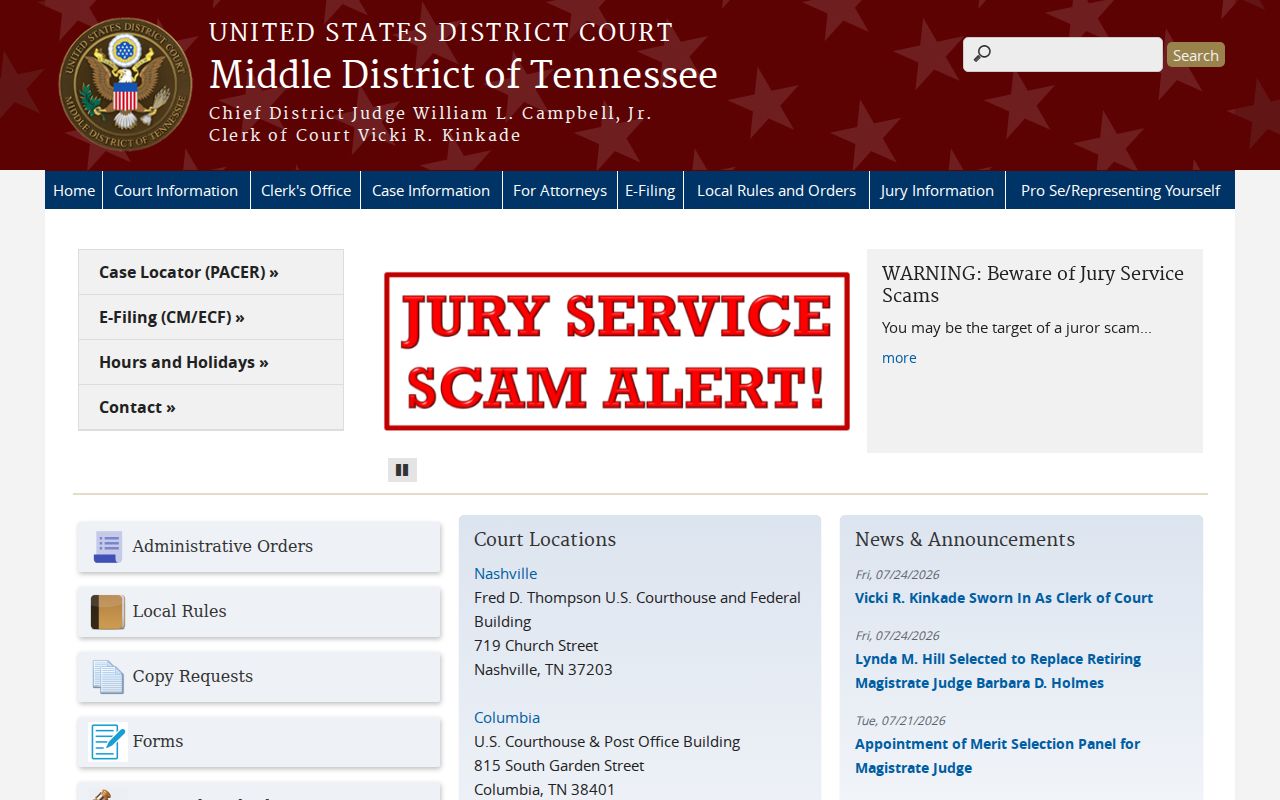
Federal case numbers for the Columbia Division use division digit “1,” a useful clue when reading a docket reference.
Filed documents and docket sheets are searched through PACER, which requires registration and applies the federal judiciary's current fee schedule.
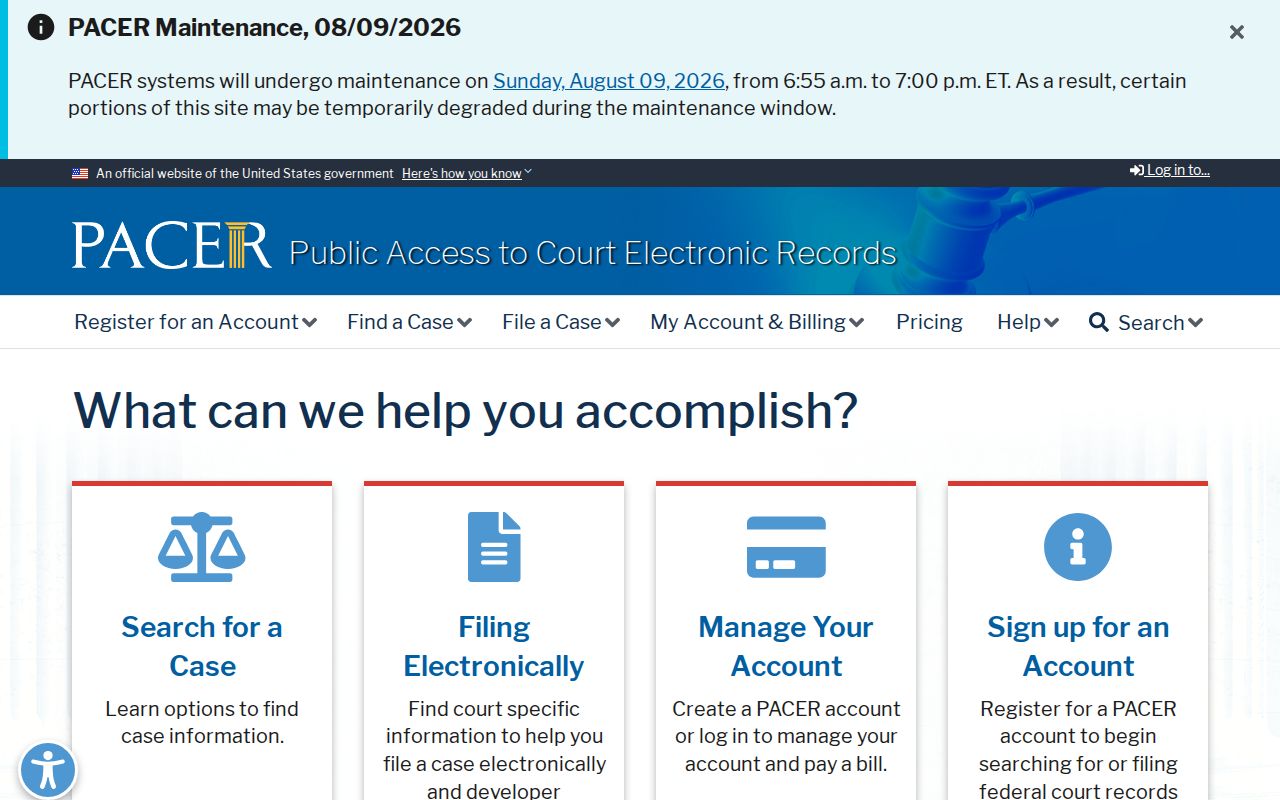
PACER is the official remote system for the federal case that the Gaines Street county docket cannot find.
Access Rules for Case Records
The Lawrence County government directory provides the local route to court offices. Tennessee citizens may inspect public county records during business hours under the Tennessee Public Records Act, T.C.A. §10-7-503, unless another law protects the material. T.C.A. §10-7-504 lists confidential categories. A court order or judiciary rule may also seal or restrict part of a file.
Juvenile court and law-enforcement records are generally protected under T.C.A. §37-1-153, subject to statutory exceptions. Personal identifiers, victim-protected facts, medical information, and sealed documents may be withheld or redacted. Tennessee Rule of Criminal Procedure 16 governs discovery between parties. It is not a general public-record portal.
When a case does not appear, ask the clerk for the public portion by court, party, case number, and approximate filing date. Older court material may have moved to Lawrence County Archives, which generally holds permanent county records from 1818 through the mid-1990s. Newer records remain with their originating office. An absent online result can mean a spelling issue, a wrong court, a restricted file, a recent update, or an older non-indexed record. It does not settle whether the case exists.